
Use this savings calculator to estimate how your savings balance can grow over time. Enter your starting deposit, regular contribution, savings period, and expected annual percentage yield, or APY, to see a future value estimate for your money.
The calculator is useful for everyday goals like building an emergency fund, saving for a car, planning a house down payment, comparing savings accounts, or seeing how a higher interest rate can change your result. It is an educational tool, so the final amount is an estimate rather than a guarantee from a bank, credit union, or investment company.
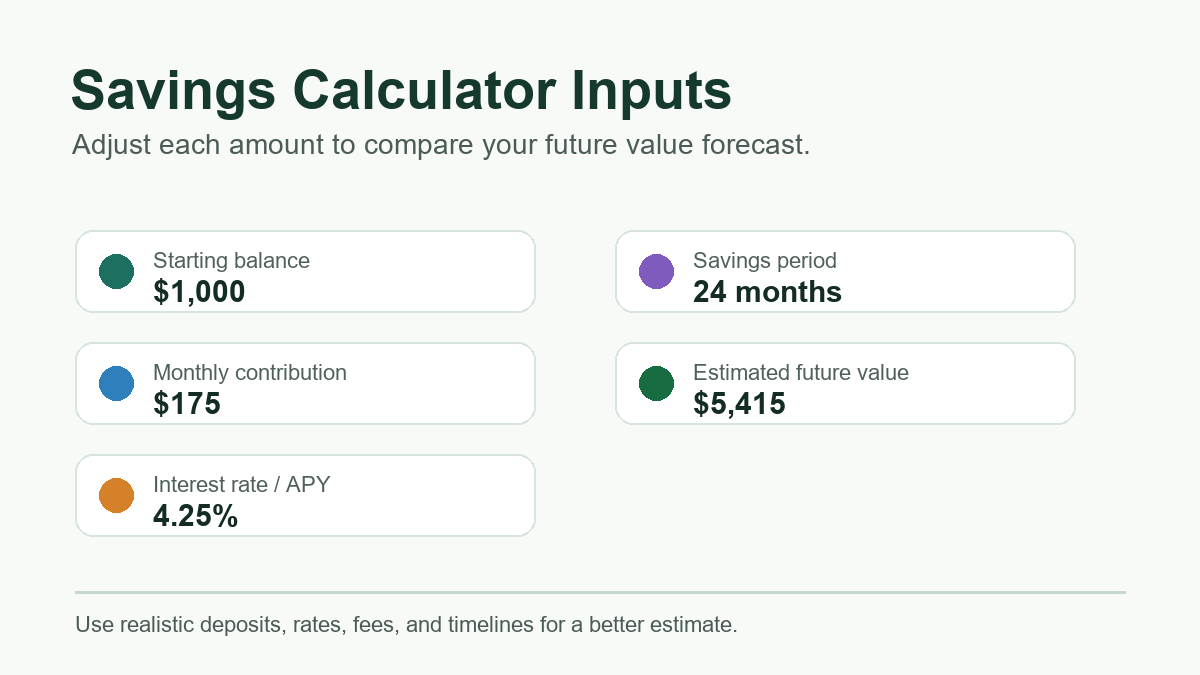
This educational personal finance content works best when you treat the calculator as a planning forecast rather than a bank quote. Review the amount you enter for principal, deposits, APY, compounding period and savings goal date so the projection reflects the way you actually plan to use the account.
How to use the savings calculator
- Enter your starting balance. Add the principal you already have saved. If you are starting from zero, enter 0.
- Add your regular deposits. Include the amount you plan to contribute each month or each pay period. Regular deposits are often the biggest driver of savings growth.
- Choose the time period. Set the number of months or years until you need the money. A longer period gives compound interest more time to work.
- Enter the interest rate or APY. Use the rate from your savings account, money market account, CD, or other deposit account. If the account advertises APY, use that number for a closer estimate.
- Review the results. Compare the ending balance, total deposits, and interest earned so you can decide whether your plan matches your goal.
What the results mean
The result shows the future value of your savings based on the information you enter. Future value is the estimated balance after your initial deposit, ongoing contributions, interest rate, and time period are applied.
- Starting balance: the money already in your account.
- Contribution: the recurring deposit you add to the account.
- Interest rate or APY: the return your savings account pays over a year.
- Compounding: the process of earning interest on both your original principal and prior interest.
- Ending balance: the estimated amount available at the end of the savings period.
Small changes can make a noticeable difference. A higher monthly contribution, a better APY, fewer account fees, or a longer timeline may help you reach the same savings goal with less pressure on your budget.
Inputs that affect your savings forecast
For a clearer savings accumulation forecast, compare more than one set of inputs before you commit to a plan. Changing the contribution amount, deposit timing, interest rate, account fees, compounding period or expected return can shift the future value estimate and show whether your strategy still fits your budget.
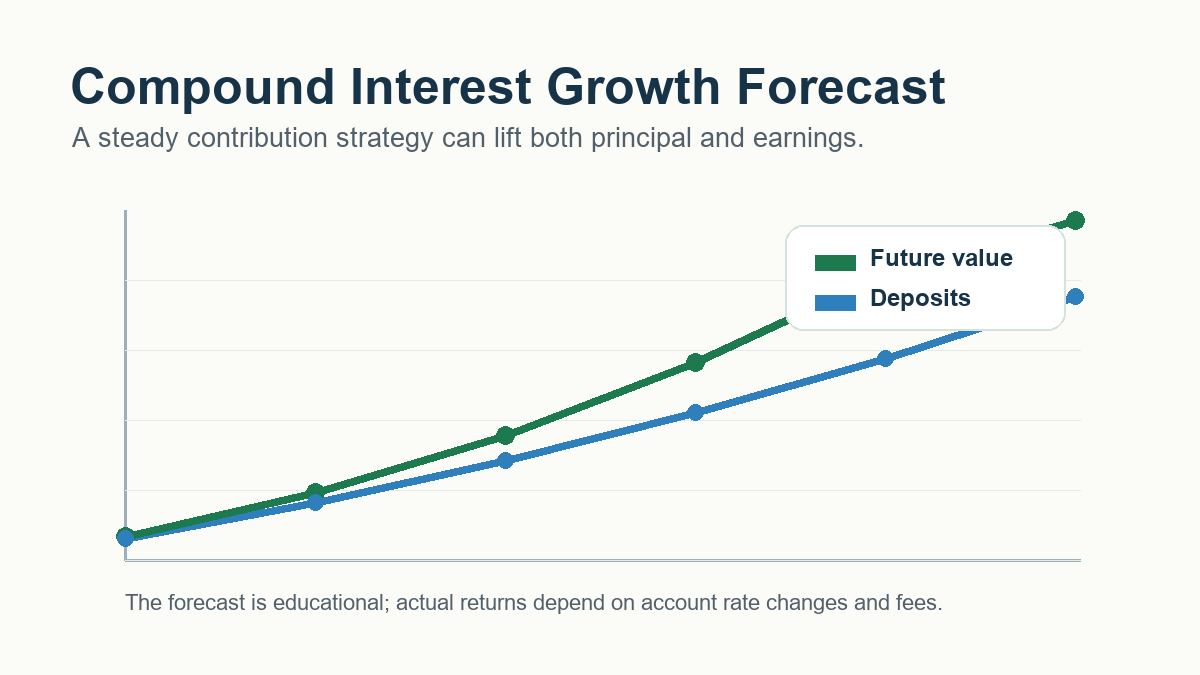
Use this savings calculator alongside other calculators and resources when you compare a savings account with CDs, money market accounts, checking accounts, retirement accounts, investment returns, loans or credit cards. That keeps the tool focused on savings growth while reminding you that debt costs, account rules and investment risk can change the final estimate.
Compare different savings scenarios
Run more than one calculation before choosing a plan. For example, compare a traditional savings account with a high-yield savings account, or test whether a CD, money market account, or checking account with interest could produce a better result for your needs.
| Scenario to test | What to change | Why it matters |
|---|---|---|
| Save faster | Increase the monthly deposit | More contributions raise the balance even if rates stay the same. |
| Earn more interest | Compare APY or interest rates | A higher rate can improve growth, especially over longer periods. |
| Lower account costs | Check monthly fees and minimum balance rules | Fees reduce your effective return and can slow progress. |
| Plan for a deadline | Adjust the savings period | A shorter deadline usually requires a larger recurring contribution. |
Example savings goal
Suppose you want to save $5,000 for a car repair fund in two years. If you already have $1,000 saved, you can enter that as your starting balance, add your planned monthly contribution, and test different APY assumptions. If the projected ending balance is below $5,000, try increasing the deposit, extending the timeline, or moving the money to a savings account with a better rate.
If the deadline is tied to a specific purpose, use the result as a starting point and then choose the right follow-up tool. A savings goal calculator can help with a short-term target, a college savings calculator can frame education costs, and a retirement calculator is better for IRA or long-term retirement planning assumptions.
When a savings calculator is most helpful
A savings calculator works best when you need a quick projection for a clear financial goal. It can help with emergency savings, vacation funds, annual insurance bills, a home down payment, education expenses, or retirement savings outside a formal retirement calculator.
For retirement, investing, loans, mortgages, credit cards, and debt payoff, use this calculator as a basic planning tool only. Investments can rise or fall in value, loans add borrowing costs, and inflation can reduce purchasing power over time. A financial advisor, bank, or credit union can provide advice for a specific account, product, or long-term strategy.
Tips for a more accurate estimate
- Use the current APY from your bank or credit union instead of guessing.
- Include only deposits you can realistically make from your income or paycheck.
- Check whether the account has fees, minimum balances, or withdrawal limits.
- Update the calculation when rates, goals, or your budget change.
- Compare more than one savings account before opening a new account.
The best savings plan is usually the one you can follow consistently. Use the calculator to turn a goal into a monthly number, then adjust your budget until the plan feels realistic.
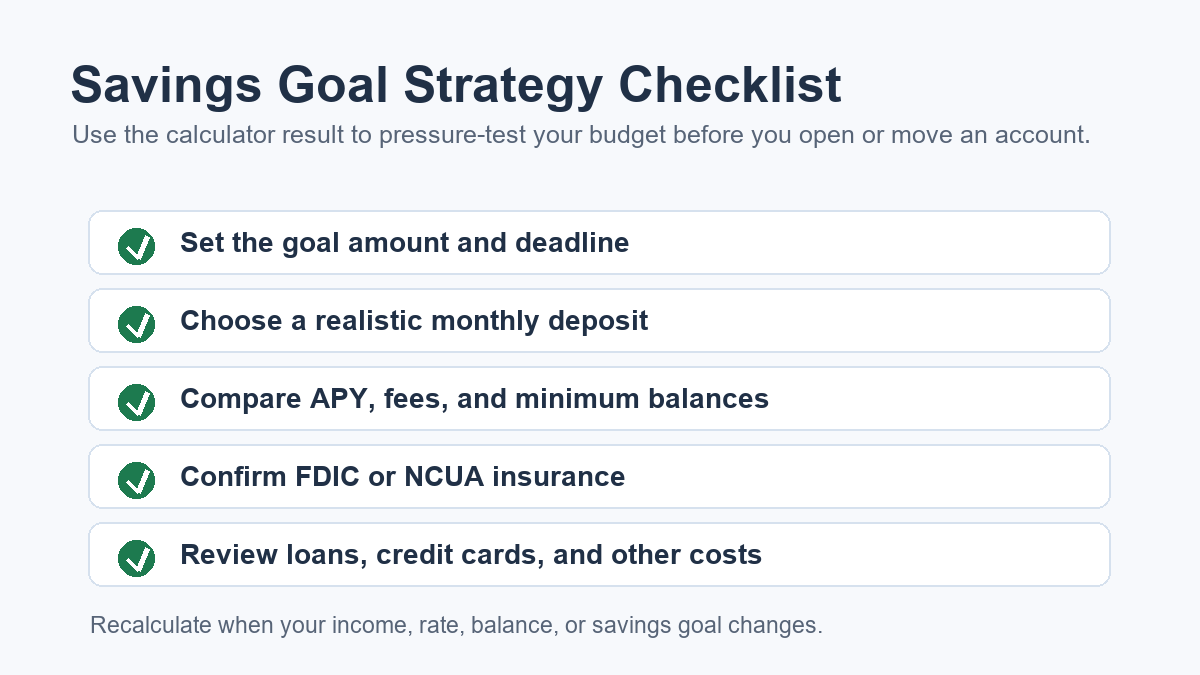
Revisit the calculation whenever your income, paycheck timing, balance, rate, savings goals or debt obligations change. The strongest plan is usually a simple finance routine you can repeat without relying on perfect market conditions or unusually high returns.
Use this with other banking tools
Compare savings accounts and calculators
This site focuses on practical savings content, but no single calculator answers every financial question. Use this savings calculator for cash goals, then compare it with other calculators or banking resources when you need to estimate mortgage payments, loan costs, credit cards, IRAs, retirement accounts, or investment returns.
Check account safety and fees
If you are comparing U.S. banks, online banks, or credit unions, review the APY, minimum balance, monthly fees, deposit rules, and whether the institution is Member FDIC or NCUA insured. These factors are part of choosing a savings account because fees and account rules can reduce the value of your interest earnings.
Know the accuracy limits
The results are only as accurate as the information you enter. Rates can change, people may pause deposits, monthly expenses can shift, and investors may need different tools for market risk across a broader portfolio. If you have questions about taxes, investments, long-term wealth planning, or a savings order of priorities, consider comparing resources from your bank or speaking with a qualified financial planner or professional.