
Use this retirement calculator to estimate whether your current savings, monthly contributions, age, retirement age, and expected investment return are on track for the retirement income you want. The result is a planning estimate, not a guarantee, but it gives you a practical starting point for comparing different retirement scenarios.
The calculator can help you test how much money you may have at retirement, how long your nest egg could last, and what changes may improve your plan. Adjust one input at a time so you can see the effect of saving more, retiring later, changing the expected return, or planning for higher expenses.
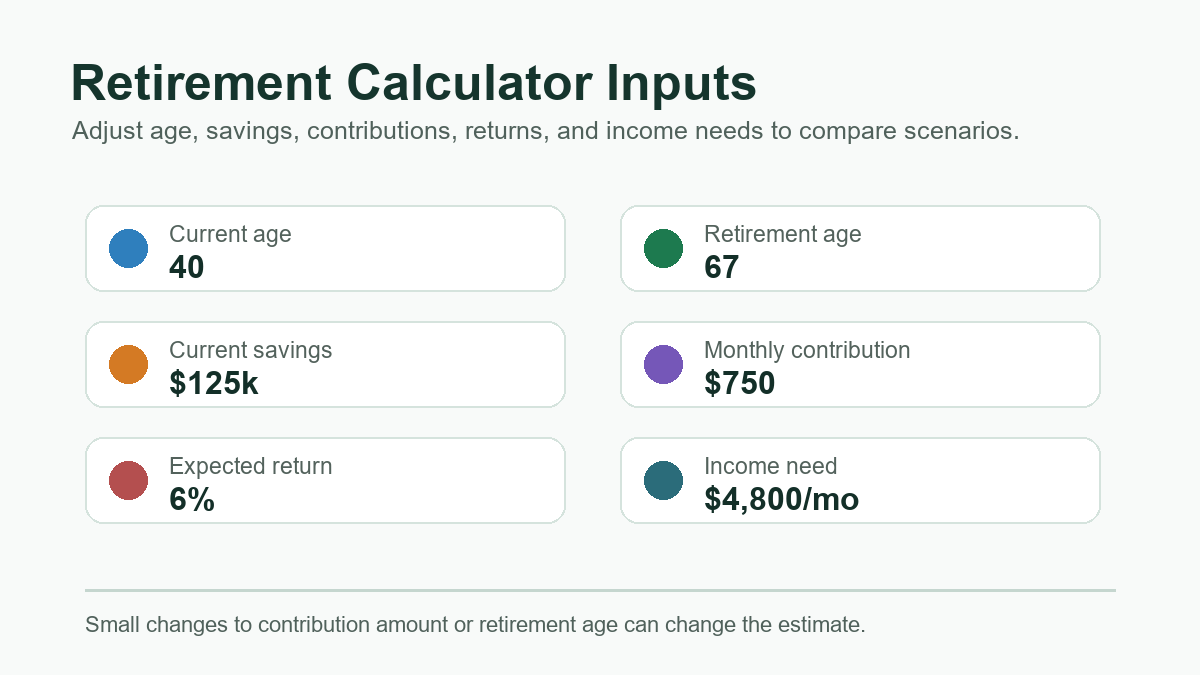
Use the estimate to compare different ways to improve your retirement savings, such as raising paycheck contributions, changing retirement age, updating return assumptions, or reducing future expenses. Because longevity can change how long the money must last, treat the result as a scenario tool rather than a guaranteed value from any financial services company.
How to use the retirement calculator
- Enter your current age and retirement age. This sets the number of years your savings have to grow before retirement.
- Add your current retirement savings. Include money in retirement accounts, IRAs, 401(k) plans, taxable investments, or other accounts you want to count.
- Enter your monthly contribution. Include your own savings plus any employer match if the calculator asks for it separately.
- Choose an expected rate of return. Use a realistic return assumption based on your investment mix, risk tolerance, and time horizon.
- Review the estimated results. Compare the projected balance, retirement income, and savings gap to decide what part of your plan may need attention.
Key inputs that affect your retirement estimate
Age, time horizon, and retirement age
Time is one of the most important factors in retirement planning. Starting earlier gives contributions and investment returns more years to compound. Retiring later can also help because it may add more working years, reduce the number of retirement years you need to fund, and change when you claim Social Security benefits.
Contributions and employer match
Your regular contribution amount matters more than most people expect. If your employer offers a 401(k) match or similar workplace retirement plan benefit, include that employer money when estimating total savings. Employer contributions can be a major part of a retirement plan.
Expected returns, risk, and inflation
Investment returns are uncertain. Stocks, bonds, mutual funds, and other investments can rise or fall, and higher expected returns usually come with more risk. Inflation also matters because future expenses may cost more than they do today. Run a conservative case and a stronger-growth case so your estimate is not built on one assumption.
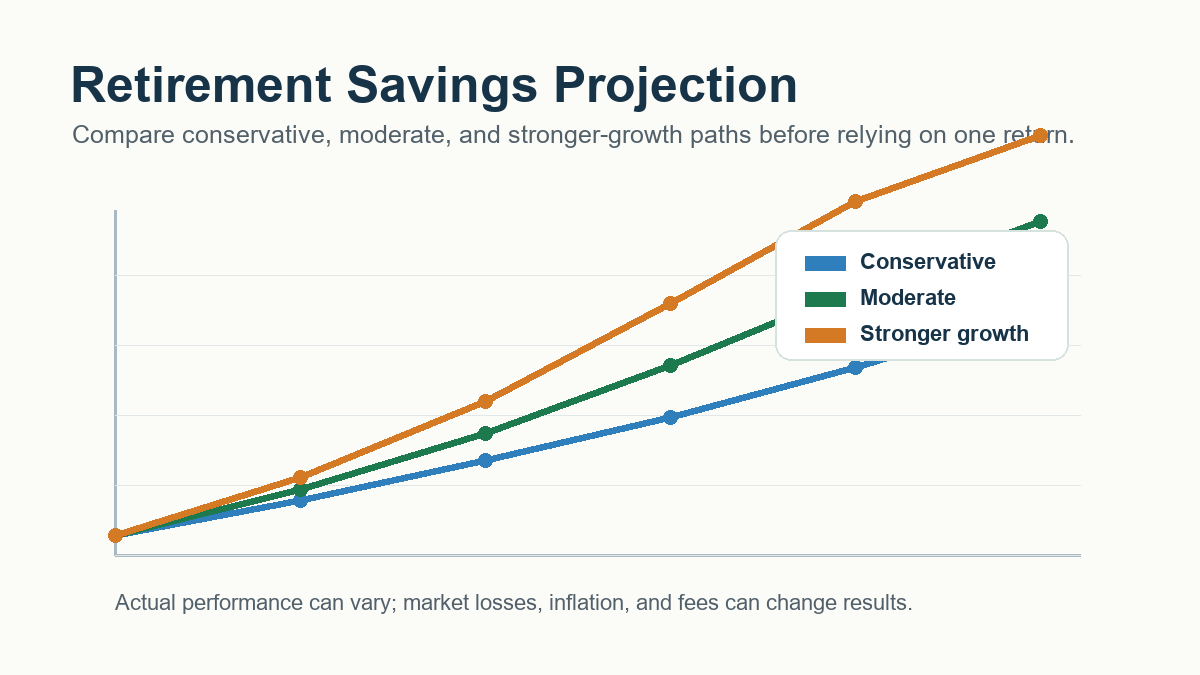
Compound interest can increase the value of early contributions, but the same portfolio can also experience loss in weak markets. Compare conservative, moderate, and stronger-growth calculations so your retirement plan does not depend on one rate of return or one market performance assumption.
Retirement accounts and income sources to consider
A retirement calculator works best when it includes the major sources of money you expect to use later. Common retirement accounts and income sources include:
- Employer plans: 401(k), 403(b), 457, Thrift Savings Plan, pensions, and employer matching contributions.
- IRAs: Traditional IRA, Roth IRA, rollover IRA, and other individual retirement accounts.
- Taxable investments: Brokerage accounts, stocks, bonds, ETFs, mutual funds, and cash reserves.
- Social Security: Benefits may become one part of retirement income, but the amount depends on your earnings history and claim age.
- Other sources: Rental income, annuities, pension payments, business income, or part-time work.
What the results mean
The calculator result is an estimate of your future retirement savings and potential retirement income. If the result is below your target, you can test a few changes: increase contributions, reduce expected retirement expenses, retire later, review investment risk, or compare different account types.
| Scenario | Input to adjust | What it shows |
|---|---|---|
| Save more now | Monthly contribution | How extra savings may affect the final account balance. |
| Retire later | Retirement age | How more working years may improve the projection. |
| Lower risk assumption | Expected return | How a conservative return may change the estimate. |
| Plan for higher expenses | Retirement income need | Whether your savings can support a larger monthly budget. |
Compare ways to close a retirement savings gap
If the calculations show a shortfall, use the calculator to test practical options: increase the paycheck contribution amount, add employer benefits, reduce expenses, delay retirement, or adjust the withdrawal strategy. These examples help turn a result into a planning checklist instead of a single number.
Do not forget expenses, taxes, and insurance
Retirement planning is not only about the account balance. Expenses, taxes, health insurance, Medicare costs, long-term care risk, and withdrawal strategy can all affect how much retirement income you actually keep. Some retirees also need to plan for required minimum distributions, Roth IRA tax treatment, pension choices, and how withdrawals interact with Social Security.
Because rules and contribution limits can change, use current information from your plan provider, IRA custodian, employer benefits team, or government resources before making a decision. The calculator is a helpful tool for planning, but it should not replace personalized financial, tax, investment, or insurance advice.
Plan for longevity and changing expenses
Longevity is one of the biggest retirement planning variables because a longer retirement may require more income, more cash reserves, and a more flexible withdrawal plan. For comparison purposes, keep your inputs in today’s dollars unless the calculator specifically adjusts for inflation, and update rates, taxes, insurance costs, and benefits when new information is available.
Example retirement planning check
Suppose you are 40, want to retire at 67, already have money in a 401(k), and contribute every month. You can enter those numbers, test a realistic return, then compare the result against your expected retirement expenses. If the projection is short, you might raise contributions, include an employer match, adjust the retirement age, or review your investment allocation with a qualified financial advisor.
When to use other financial tools
This retirement calculator is built for a broad planning estimate. Other retirement calculators and resources may be better for a single question, such as Social Security benefits, IRA contribution planning, pension choices, mortgage payoff, debt reduction, emergency savings, or investment fees. If you are still building short-term savings, you may also want to use our savings calculator to plan cash goals outside your retirement accounts.
Portfolio details to review
For U.S. retirement planning, look beyond one account balance and review the details of your full portfolio. Assets may include cash, CDs, IRA balances, employer plan investments, taxable brokerage accounts, bonds, stocks, pensions, annuities, and other savings. Each asset can have a different return, risk level, tax treatment, and role in your retirement income plan.
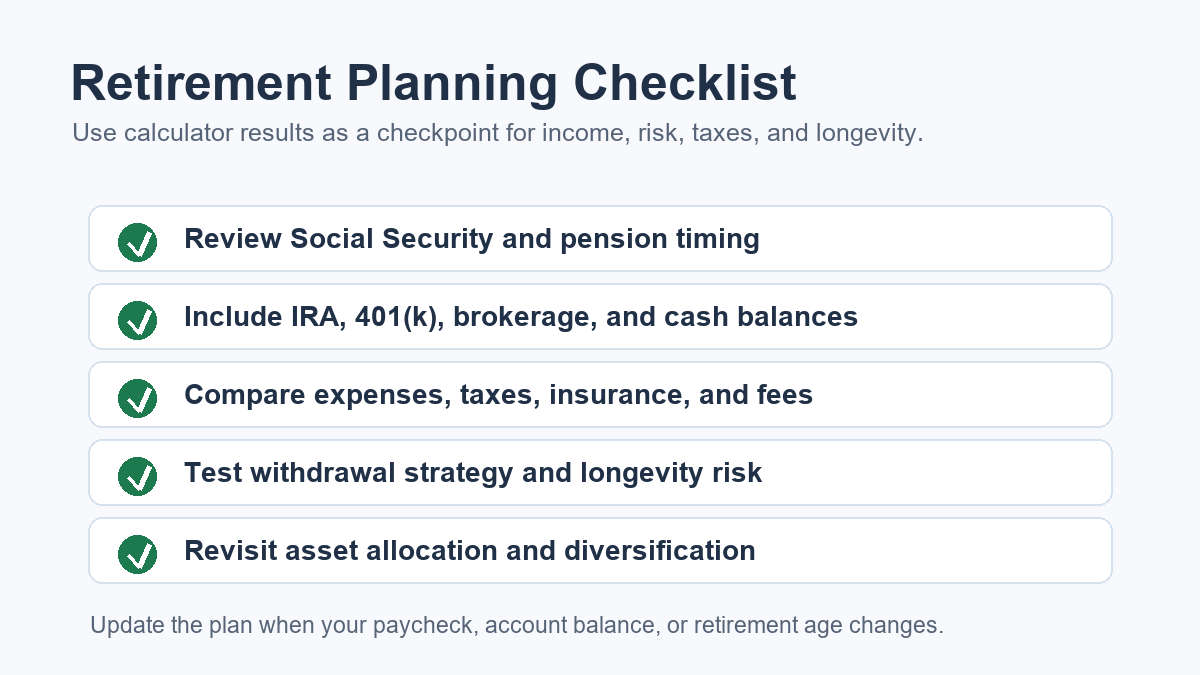
Review asset allocation and diversification
Look at asset allocation across investment accounts, cash, savings accounts, CDs, stocks, bonds, mutual funds, ETFs, annuities, and pension sources. Diversification cannot prevent loss, but it can help align investment products with your risk tolerance, income needs, time horizon, and retirement goals.
If you need answers about a specific account, withdrawal order, insurance need, investment advice, or investment strategy, compare your calculator results with information from the account provider and consider asking qualified financial advisors, tax experts, or investment professionals. The best way to use this content is as a planning checkpoint, not as a substitute for advice based on your personal needs.
Tips for better retirement calculator accuracy
- Use realistic income, savings, and contribution information.
- Run multiple return assumptions instead of relying on one number.
- Include employer contributions, IRA savings, and other retirement accounts.
- Consider inflation, taxes, insurance costs, and life expectancy.
- Update the calculation when your income, expenses, benefits, or investment strategy changes.
The goal is not to predict retirement perfectly. The goal is to understand the direction of your plan, spot gaps early, and make informed changes while you still have time to adjust.