

Last updated: June 26, 2026
The short answer is yes: Metro does offer deals to existing customers, but the best deal depends on your plan, line age, trade-in status, and whether you are upgrading, adding a line, or moving to T-Mobile postpaid.
Featured Snippet Answer: Does Metro Offer Deals to Existing Customers?
Short answer: Yes. Metro by T-Mobile offers existing-customer deals through eligible upgrade programs, trade-in credits, add-a-line promotions, plan perks, AutoPay savings, and the Smartphone Equality path to T-Mobile. The strongest upgrade benefit is tied to eligible plans: Metro states that customers on the $50 with AutoPay or $60 with AutoPay plans can trade in a working phone after 12 months and get the same deals as new customers on select devices. However, many heavily advertised free-phone and ultra-low monthly plan deals are restricted to new customers, customers who bring a number, or bring-your-own-device activations.
The Honest Answer: Yes, But Not Every Deal Is for Existing Customers
The search intent behind does Metro offer deals to existing customers is usually frustration. A current customer sees an ad for a free Samsung, a discounted iPhone, or a $20 unlimited plan and wonders why it seems easier to save money by leaving than by staying. That feeling is understandable because wireless carriers often use the biggest discounts to attract new lines.
Metro separates promotions into categories. Some offers are for switchers. Some are for customers adding a new line. Some are for bring-your-own-phone customers. Others are for existing customers who meet upgrade requirements. The key is not simply asking, “Am I already a customer?” The better question is: “Which customer action makes me eligible?”
Existing Customer Deal Options at a Glance
| Deal type | Existing customer potential | What to check before acting |
|---|---|---|
| Eligible plan upgrade | High | Whether your line has completed the required 12-month countdown and whether your phone works |
| Trade-in credit | Medium to high | Device condition, IMEI, model value, and qualifying purchase type |
| Add-a-line phone deal | Medium | Whether you truly need another line long term |
| Plan change or AutoPay savings | Medium | Whether changing plans improves value without losing a grandfathered price |
| T-Mobile Tuesdays and plan perks | Medium | Whether your plan includes the perk and whether you use it |
| Smartphone Equality migration | Medium | Whether you have 12 consecutive on-time payments and want T-Mobile postpaid |
| “Free phone when you switch” deals | Usually low | Whether the offer requires a new customer, port-in, or BYOD activation |
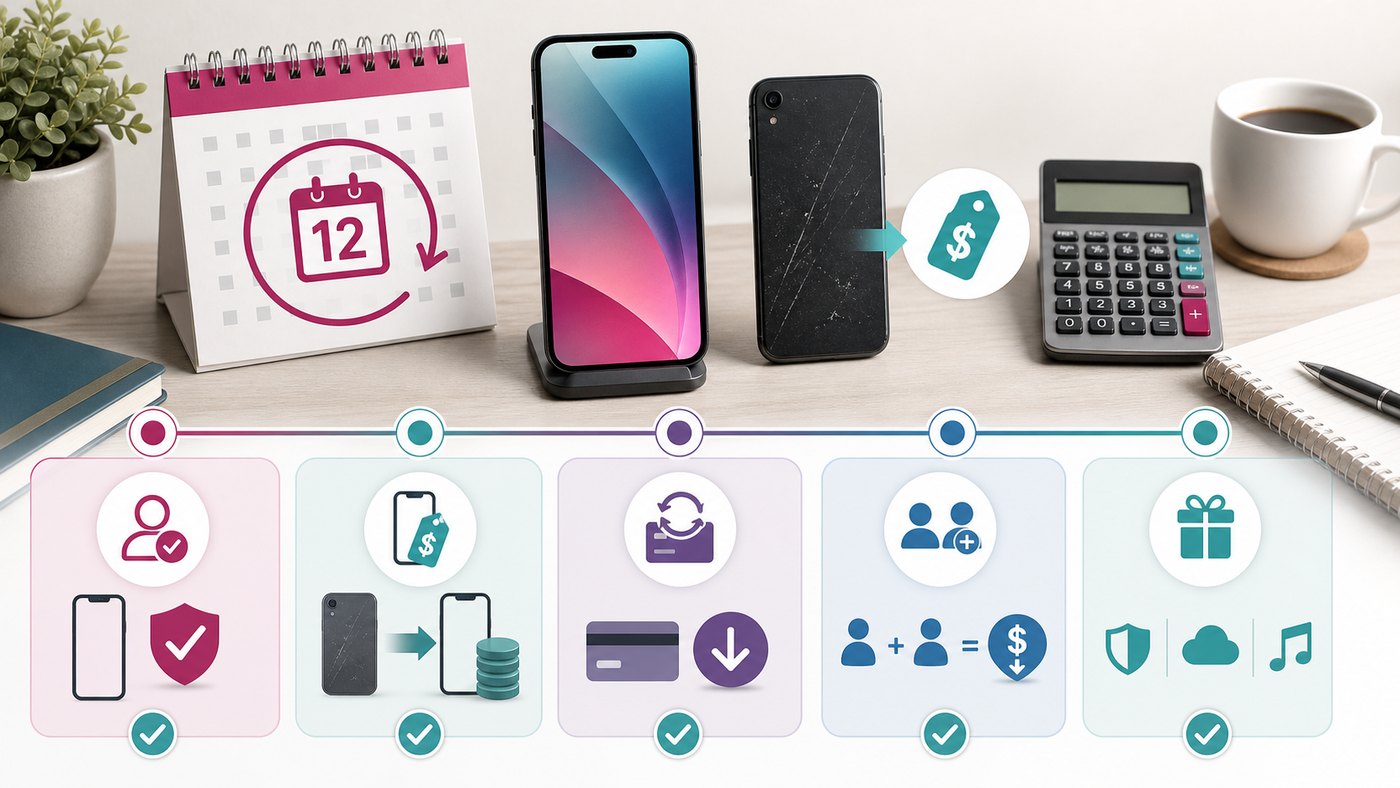
1. Metro Upgrade Deals for Current Customers
Metro’s clearest existing-customer deal is the built-in upgrade benefit on eligible plans. Metro’s upgrade page says customers can get the same deals as new customers on select devices when they trade in a working phone after 12 months on the $50 with AutoPay or $60 with AutoPay plans. Metro also notes that the benefit can apply on up to four lines, with each line having its own countdown.
This matters because it changes the old prepaid-carrier expectation that loyal customers always pay full retail price. Under the current structure, an existing customer may be able to wait out the eligibility period, trade in a working device, and access select new-customer-style offers without leaving Metro.
The catch is that “same deals as new customers” does not mean every phone is free for every person. It usually means select devices, specific plans, tax obligations, device condition requirements, and promotional terms. If you want a premium phone or a no-trade-in deal, read the terms line by line before assuming the ad applies.
Practical example
Imagine you have one line on an older plan and one line on an eligible current plan. The line on the current eligible plan may be building upgrade eligibility, while the older line may not qualify the same way. Because each line can have its own countdown, two people on the same account may not have the same upgrade options.
2. Trade-In Credits Can Help Existing Metro Customers
Metro’s trade-in program is another path that can benefit current customers. Metro says new or current customers with a qualifying transaction, including new activations, add-a-lines, or upgrades with a device purchase-may be eligible to trade in their phones. That language matters because it explicitly includes current customers.
A trade-in is not the same as a blanket loyalty discount. Your savings depend on the device model, condition, and promotion attached to the purchase. A newer iPhone in good condition will usually have more value than an older Android with a cracked screen or battery problems.
Before trading in a device, take photos of the phone, record the IMEI, back up your data, remove account locks, and compare the offer against unlocked-phone sales. Sometimes the best Metro existing customer deal is not a carrier promotion at all; it is buying an unlocked phone at a sale price and keeping your current plan.
3. Add-a-Line Promotions May Work, But Only If You Need the Line
Many Metro promotions are written around new lines. That can help an existing customer who genuinely needs to add a spouse, child, parent, tablet, or second phone. It can be a poor deal if the extra line is added only to chase a device discount.
The math is simple. A “free” phone is not free if you pay for a line you do not need. Suppose a device discount saves $200, but the extra line costs $25 per month for a year. That is $300 in service before taxes, fees, or plan changes. In that case, the promotion may cost more than buying a discounted phone outright.
Use add-a-line deals only when the line has a real purpose. Families can benefit most because Metro often promotes multi-line pricing, and the monthly cost per line may fall as more lines are added.
4. Existing Customers Can Save Through Plan Perks and AutoPay
Not every deal is a new phone. Metro’s value also includes plan perks. Depending on the plan, customers may receive benefits such as a 5-year price guarantee on talk, text, and data, Scam Shield, T-Mobile Tuesdays, hotspot data, Google One, or Amazon Prime on higher-tier plans.
AutoPay can also matter. Many Metro offers are displayed with an AutoPay price, and the difference between paying manually and using AutoPay can change the real monthly cost. This is especially important for customers comparing the $50 and $60 plan tiers, because those plans are central to Metro’s current upgrade-benefit messaging.
The best plan is not automatically the cheapest plan. A $60 plan that includes a valuable perk you use every month may beat a $40 plan plus separate subscriptions. On the other hand, paying for perks you ignore is wasted spend.
5. Smartphone Equality: A Different Kind of Existing-Customer Deal
Metro’s Smartphone Equality program is not simply a Metro phone discount. It is a bridge from Metro to T-Mobile postpaid. Metro says customers who make 12 consecutive on-time payments and are in good standing may qualify to move to T-Mobile and access device financing with $0 down for most 5G smartphones, without a credit check.
This can be useful for customers who want premium devices, postpaid benefits, or installment options that are not available in the same way on prepaid. It is less attractive if you chose Metro because you want simple prepaid pricing, no postpaid bill structure, and no long-term device financing.
Treat Smartphone Equality as a separate decision. You are not just asking whether Metro offers an existing-customer deal. You are asking whether moving to T-Mobile improves your total phone, plan, and perk value.
Why New-Customer Metro Deals Often Look Better
Switcher deals are designed to solve one problem for the carrier: growth. Carriers pay more to win a customer they do not already have. That is why the most aggressive promotions often require a port-in, a new account, a new number, a bring-your-own-device activation, or a minimum plan tier.
For example, Metro’s 6-month unlimited 5G promotion advertises a low effective monthly rate, but Metro describes it as a new-customer BYOD offer. Likewise, free-phone promotions commonly require a new line, a number transfer, or a qualifying plan. Existing customers can still find value, but the eligibility rules are different.
This is why current customers should avoid comparing only the headline price. Instead, compare the total 12-month cost: first month of service, device price after discount, sales tax, activation fees, required plan tier, AutoPay requirement, extra line cost, trade-in value, and any lost grandfathered pricing.
How to Check Your Metro Existing-Customer Deal Eligibility
Start in your Metro account or the myMetro app. Deals can look different when the site knows you are upgrading instead of starting a new account. If you browse as a new customer, you may see offers that do not apply to your line.
Next, check your exact plan name and AutoPay status. Metro’s upgrade language specifically references the $50 with AutoPay and $60 with AutoPay plans. If you are on an older grandfathered plan, ask whether changing plans improves eligibility or raises your long-term cost.
Then confirm your line’s upgrade countdown. If your plan includes upgrades, ask when the specific line becomes eligible. Metro says each line can have its own countdown. Also verify whether a device swap, cancellation, or other account change could restart the clock.
Finally, price the deal three ways: Metro upgrade price, Metro trade-in price, and unlocked retail price. Before checkout, ask for the total due today and the monthly cost after the transaction, including taxes, accessories, protection plans, and optional add-ons.
Smart Ways to Maximize Metro Deals as an Existing Customer
Keep payments on time, protect your phone, and keep AutoPay active if your target plan depends on AutoPay pricing. These habits support eligibility and protect trade-in value. It also helps to check deals around major retail periods such as back-to-school, Black Friday, and new device launches.
Be flexible about device brands. Existing-customer promotions may be stronger on Motorola, Samsung A-series, REVVL, or select midrange 5G phones than on the newest iPhone Pro. The best value often sits in the middle of the device lineup, where discounts are meaningful and monthly service costs stay manageable.
Finally, ask a Metro store or customer care representative to compare upgrade, add-a-line, and plan-change scenarios. Ask for the final price breakdown in writing. A clear quote prevents surprises.
Common Mistakes Existing Metro Customers Make
The biggest mistake is assuming every ad applies to every account. The second is adding a line for a phone discount without calculating the line cost. The third is trading in a phone without backing up data or removing account locks. The fourth is changing away from a grandfathered plan without checking whether the old price or perks can be restored.
Another common mistake is ignoring taxes. Even when a phone is promoted as free, customers may still owe sales tax based on the device price. That can make a “$0 phone” transaction more expensive than expected at checkout.
Verdict: Is Metro Good to Existing Customers?
Metro can be good to existing customers, especially those on eligible plans who keep service active, pay on time, maintain a working phone for trade-in, and understand the rules before shopping. The strongest existing-customer value is often a combination of annual-style upgrade eligibility, trade-in value, AutoPay pricing, plan perks, and multi-line savings.
Still, Metro’s best public promotions often favor new customers. Current customers should compare their upgrade options against unlocked phone sales and competing prepaid carriers. Staying loyal makes sense when the total cost is better, not just when the discount looks convenient.
F.A.Q: Less Common Questions About Metro Existing-Customer Deals
Does Metro give loyalty discounts just for being a long-time customer?
Metro does not consistently advertise a universal loyalty discount for every long-time customer. Instead, existing-customer value is usually tied to plan eligibility, trade-in status, upgrade timing, AutoPay, line additions, or migration eligibility.
Can an existing Metro customer get a free phone without adding a line?
Sometimes the best free-phone offers require a new line, number transfer, or qualifying new activation. Existing customers should check the upgrade page while logged in, because eligible plan customers may qualify for select device deals after the required period and trade-in.
Does the 12-month upgrade clock apply to the account or each phone line?
Metro says eligible upgrades can apply on up to four lines and that each line has its own countdown. That means one line may be eligible before another, even on the same account.
Can I switch from Metro to T-Mobile and get phone deals?
Yes, but this is not the same as staying on Metro. Through Smartphone Equality, eligible Metro customers with 12 consecutive on-time payments can move to T-Mobile postpaid and may access T-Mobile device financing and promotions if they meet the terms.
Is it better to upgrade through Metro or buy an unlocked phone?
It depends on the final cost. Upgrade through Metro when the device discount and plan requirements beat unlocked retail pricing. Buy unlocked when the sale price is strong, the phone is compatible, and you want to keep a cheaper Metro plan.
Final Takeaway
Does Metro offer deals to existing customers? Yes, but the winning strategy is to match the right deal type to your account. Look first at eligible upgrade benefits, trade-in credit, AutoPay pricing, perks you actually use, and Smartphone Equality if you want to move to T-Mobile.